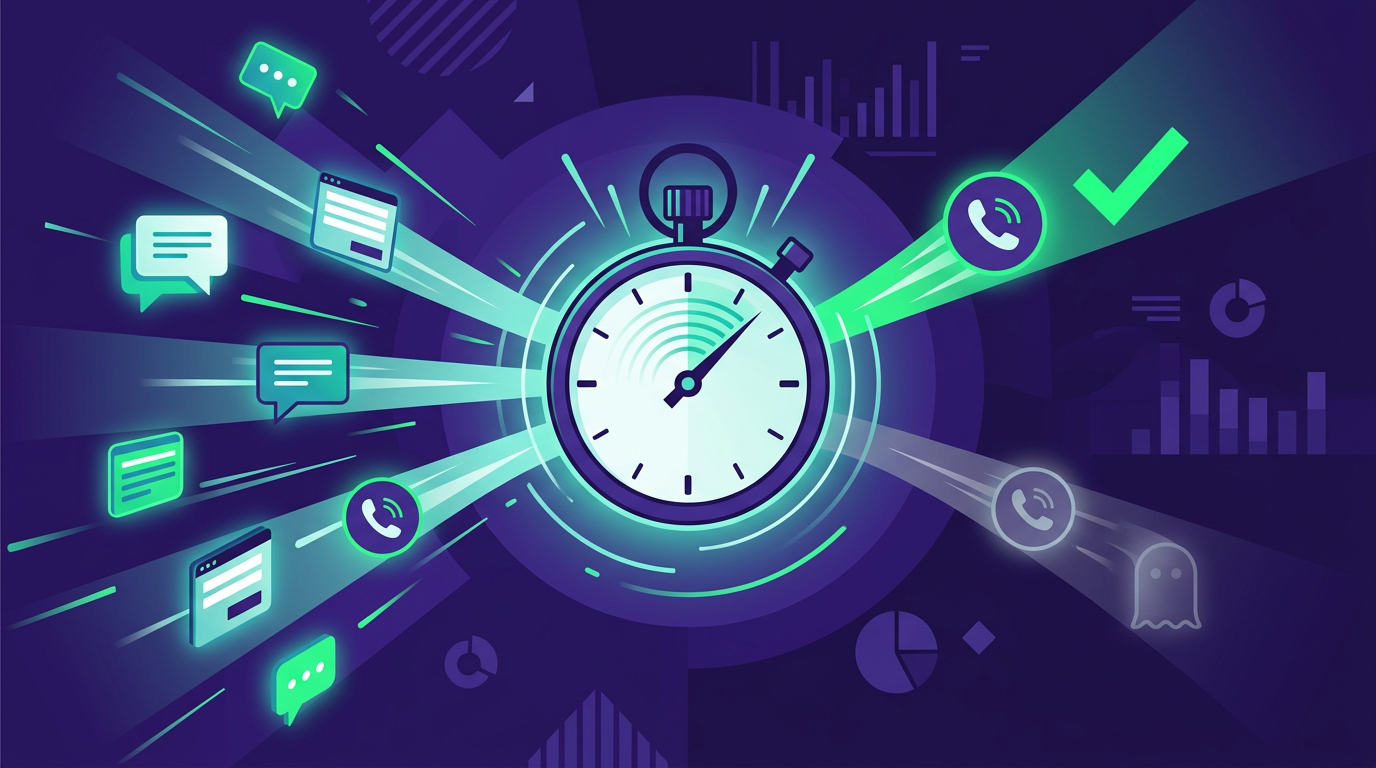
Why Lead Response Speed Matters More Than Your Ad Budget
The Most Expensive Leak in Your Funnel
Businesses spend thousands of dollars per month driving traffic to their websites. They invest in Google Ads, SEO, social media, and content marketing to get the right people to click. And then, when someone actually raises their hand and says "I am interested," the average business takes 47 hours to respond.
That is not a typo. Nearly two full days.
By that point, the lead has moved on. They have contacted a competitor. They have found another option. Or they have simply lost the urgency that made them reach out in the first place.
Lead response speed is not a nice-to-have metric. It is the single highest-leverage factor in determining whether your marketing spend converts into revenue or vanishes.
The Numbers That Should Keep You Up at Night
The research on speed-to-lead is consistent and unambiguous:
Response time directly predicts conversion:
- Leads contacted within 5 minutes have a 32% close rate, compared to 12% for those contacted after 24 hours. That is a 2.6x difference from the same leads.
- Calling within 60 seconds yields 391% more conversions than calling at the 2-minute mark.
- Leads contacted within 5 minutes are 21x more likely to enter the sales cycle than leads contacted after 30 minutes.
The first responder wins:
- 78% of customers purchase from the company that responds first, regardless of price or brand recognition.
Most businesses are failing at this:
- 63.5% of companies never respond to inbound leads at all.
- Only 23% of B2B companies respond within 5 minutes.
- 42% take longer than 24 hours.
- 81% of companies that take over an hour report losing leads to faster competitors.
These statistics reveal a massive opportunity. If your competitors are slow (and statistically, most are), being fast is one of the simplest competitive advantages you can build.
Why Most Businesses Respond Slowly
The problem is rarely about not caring. It is structural.
Manual routing is slow. A form submission comes in. It goes to a shared inbox. Someone needs to read it, decide who should handle it, forward it, and hope that person follows up. Each handoff adds minutes or hours.
Business hours create gaps. Leads do not stop coming in at 5 PM. A potential customer who fills out a form at 9 PM on a Tuesday will not hear back until Wednesday morning at the earliest, if they hear back at all.
Volume overwhelms small teams. When your team is juggling five other priorities, that new lead notification gets buried. Not out of negligence, but because there are only so many hours in the day.
No system of accountability exists. Most businesses do not track response time as a metric. If you are not measuring it, you cannot improve it.
What Fast Actually Looks Like
The 2026 benchmark consensus is clear: respond within 5 minutes or accept that you are losing deals.
But the businesses seeing the best results are not aiming for 5 minutes. They are responding in under 60 seconds. And they are doing it with AI.
Here is what an AI-powered lead response looks like in practice:
- A lead fills out a contact form on your website at 8:47 PM on a Saturday.
- Within 15 seconds, an AI agent sends a personalized text message acknowledging their inquiry and asking one qualifying question.
- The lead responds. The agent determines they are a good fit, answers their most common question about pricing, and offers three available times for a consultation.
- The lead books a Monday morning call. By the time your team arrives, the meeting is on the calendar with full context on who the lead is and what they need.
No human was involved. No lead was lost. No weekend was interrupted.
AI vs. Manual: The Performance Gap
The data on AI-powered response versus manual processes is definitive:
- 62.5% of companies using AI meet the under-15-minute response standard, compared to just 39.1% of manual-only businesses.
- Manual-only operators report 69% lead leakage, roughly 15 percentage points higher than businesses using AI.
- AI-powered routing delivers an 8x speed improvement in average response time.
The gap is not about effort. Teams using manual processes are often working harder. They just cannot match the speed, consistency, and availability that AI provides.
The Math on What Slow Response Costs You
Consider a business spending $5,000 per month on ads that generates 100 leads per month. At a 12% close rate (typical for 24+ hour response times), that is 12 customers.
Now imagine the same business responds within 5 minutes using an AI agent, achieving a 32% close rate. That is 32 customers from the same 100 leads, the same $5,000 spend.
The difference is not a marginal improvement. It is 20 additional customers per month from budget you are already spending. Depending on your average deal size, that could be tens or hundreds of thousands of dollars in annual revenue, unlocked not by spending more on ads, but by responding faster to the leads you already have.
How to Fix It
Step 1: Measure your current response time.
Check your CRM or inbox. How long does it actually take from form submission to first human (or automated) contact? Most businesses are surprised by the answer.
Step 2: Eliminate the manual routing bottleneck.
The fastest fix is removing the handoff chain. An AI marketing agent can respond instantly, qualify the lead, and either book a meeting or route to the right person with full context.
Step 3: Cover after-hours and weekends.
If your response capability drops to zero outside business hours, you are leaving money on the table. AI agents work 24/7 without shifts, PTO, or Monday morning backlogs.
Step 4: Track and optimize.
Make speed-to-lead a KPI your team reviews weekly. Set a target (under 5 minutes is the baseline; under 60 seconds is the goal) and hold the system accountable.
The Bottom Line
You can always spend more on ads. You can always chase more keywords. You can always try another platform. But none of that matters if the leads you are already generating go unanswered.
Speed-to-lead is the most underinvested, highest-return lever in most marketing operations. Fix it first, and everything else you are doing starts working harder.
Want to see how fast your lead response could be? Talk to our team about deploying AI-powered lead engagement for your business.
Ready to Elevate Your Digital Strategy?
Let our team of experts help you achieve your marketing goals with AI-powered strategies tailored to your business.