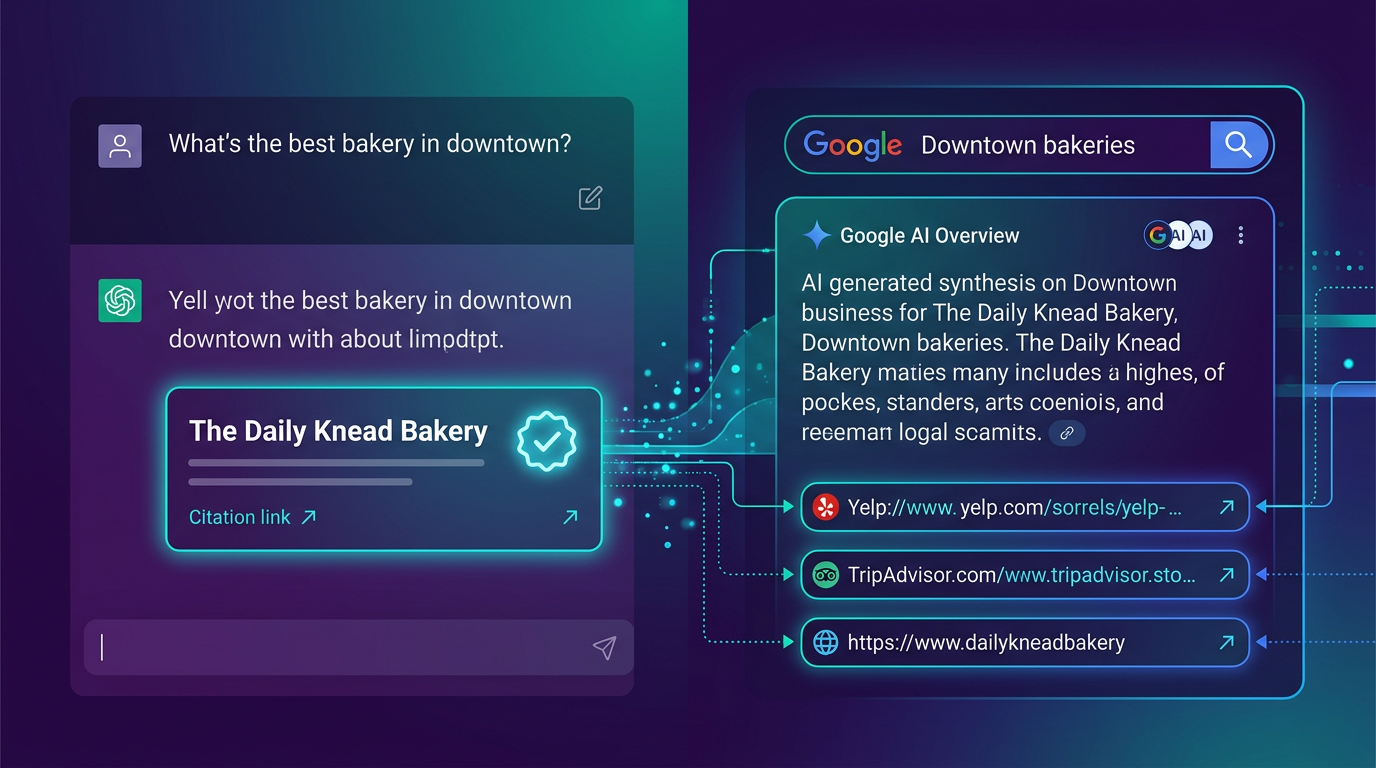
How to Get Your Business Cited in ChatGPT and Google AI Overviews
The New Visibility Problem
Your website might rank on page one for your target keywords. You might have strong reviews and a solid Google Business Profile. But there is a growing category of searches where none of that matters, because the searcher never sees a traditional results page.
When someone asks ChatGPT "What is the best HVAC company in Las Vegas?" or Google shows an AI Overview for "how much does a kitchen remodel cost?", the answer is generated from cited sources. If your business is one of those cited sources, you earn a level of trust and visibility that a standard search listing cannot match. If you are not cited, you are effectively invisible for that query.
This is not a hypothetical future scenario. Google AI Overviews now appear for a significant percentage of search queries, and millions of people use ChatGPT, Perplexity, and Claude as their primary information tools. The businesses getting cited in these answers are capturing attention and trust that their competitors are missing entirely.
How AI Systems Choose What to Cite
Understanding the citation selection process is the first step to influencing it. Different AI systems have different mechanisms, but they share common principles.
Google AI Overviews
Google's AI Overviews draw from pages that Google has already indexed and ranked. The content most likely to be cited shares these traits:
- It directly answers the query in clear, factual language
- It comes from a page with existing organic authority (backlinks, domain age, ranking history)
- It uses structured data (schema markup) that helps Google understand the content type
- It contains original information, data, or expert perspective
- The page has strong Core Web Vitals and mobile performance
The key insight: if you already rank on page one for a query, you have a realistic chance of being cited in the AI Overview for related queries. If you do not rank at all, your chances are near zero. Traditional SEO remains the foundation.
ChatGPT and Conversational AI
ChatGPT (with browsing enabled), Perplexity, and similar tools actively search the web when answering queries. They evaluate pages based on:
- Relevance to the specific question
- Clarity and structure of the content
- Authority signals (domain reputation, backlinks, citations from other sources)
- Recency of the information
- Presence of specific, factual, quotable statements
These systems are looking for pages they can confidently cite as a source. Vague marketing copy does not get cited. Specific, well-structured, authoritative content does.
Seven Strategies to Get Cited
1. Write Citable Statements
AI systems need clear, quotable statements to cite. Review your key pages and identify where you can add specific, factual claims:
Not citable: "We offer best-in-class digital marketing services that drive results."
Citable: "Our clients see an average 340% increase in qualified leads within the first 90 days of deploying AI marketing agents, based on data from 47 client engagements in 2025."
The second version gives the AI a specific data point with context. It can cite that statement and attribute it to your site.
Go through your service pages and add specific numbers, timeframes, and outcomes wherever possible. Every specific claim is a potential citation opportunity.
2. Structure Content for Extraction
AI systems parse content differently than human readers. They look for structured patterns:
- Question-and-answer format: Use the actual question as an H2 or H3 heading, followed by a direct answer in the first sentence or two
- Definition format: "X is [clear definition]." followed by explanation
- List format: Numbered or bulleted lists of steps, features, or criteria
- Comparison format: Clear side-by-side comparisons with specific attributes
Structure your most important content using these patterns. A page that says "What does AI search optimization cost? AI search optimization services typically range from $1,500 to $5,000 per month for small businesses" is far more extractable than a page with pricing buried in a paragraph of marketing copy.
3. Build Comprehensive FAQ Sections
FAQ sections are citation magnets. They match the question-answer pattern that AI systems are designed to extract, and they target the exact long-tail queries people ask AI assistants.
Every service page should have an FAQ section with 5 to 10 real questions your customers ask. Not generic filler questions, but the actual questions that come up in sales calls, emails, and consultations.
Mark up your FAQs with proper FAQ schema (JSON-LD) so search engines and AI systems can identify them structurally, not just contextually.
4. Publish Original Research and Data
The strongest citation signal is original data that does not exist anywhere else on the web. If an AI system needs to cite a statistic, it has to point to the source. Be the source.
For small businesses, original data comes from your operations:
- Survey results from your customers
- Aggregated (anonymized) performance data from your service delivery
- Cost benchmarks based on actual projects
- Year-over-year trend data from your industry
One well-researched data page can generate more AI citations than dozens of generic blog posts.
5. Implement Comprehensive Schema Markup
Schema markup is the technical foundation for AI citation. It explicitly tells AI systems what your content represents:
- Organization schema: Your business identity, contact info, social profiles
- Service schema: Each service with description, price range, area served
- FAQ schema: Questions and answers on your pages
- Article schema: Blog posts with author, date, topic
- HowTo schema: Step-by-step processes and guides
- Review schema: Customer testimonials and ratings
Our AI search optimization service includes comprehensive schema implementation as a core deliverable.
6. Maintain Active, Current Content
AI systems consider freshness when choosing citations. A page last updated in 2023 is less likely to be cited than a page updated in 2026, especially for topics where currency matters.
Review and update your key pages quarterly. Add new data, update examples, refresh statistics, and change the "last updated" date. This signals to AI crawlers that your content is maintained and current.
Blog posts also benefit from updates. Rather than only publishing new posts, revisit existing high-performing posts and update them with current information. AI agents can handle this ongoing content maintenance systematically.
7. Earn Mentions and Backlinks from Authoritative Sources
AI systems weight citations partly based on how many other authoritative sources reference the same content. A page cited by industry publications, educational institutions, or government sites carries more weight than a page with no external references.
For local businesses, this means:
- Getting featured in local business publications
- Contributing expert quotes to industry articles
- Publishing guest content on relevant trade association sites
- Earning mentions in local news coverage
- Being listed in authoritative directories (not spam directories)
Each mention reinforces your site's authority in the AI system's evaluation.
Tracking Your AI Search Visibility
Measuring AI citation performance is still an evolving practice, but there are practical approaches:
Manual monitoring: Periodically ask ChatGPT, Perplexity, and Google AI Overviews questions related to your services and see if your business appears. Document which queries cite you and which do not.
Search Console data: Google Search Console shows impressions and clicks from AI Overviews (labeled as "AI Overview" in the search appearance report). Track these metrics monthly.
Citation tracking tools: Several emerging tools track AI citations across platforms. While the space is still maturing, tools like Perplexity's publisher analytics can show when and how your content is cited.
Competitive comparison: Track the same queries for your competitors. If they are being cited and you are not, analyze what their cited pages have that yours lack.
The Compounding Advantage
AI citation is a compounding advantage. Once an AI system starts citing your content for a particular topic, it reinforces your authority for related queries. Your content gets indexed more thoroughly, your domain reputation grows, and you become the default citation for your area of expertise.
The businesses starting this work now will be difficult to displace in 12 to 18 months. The ones waiting will find themselves trying to catch up against entrenched competitors.
Start with the highest-impact actions: add specific citable statements to your top pages, implement schema markup, and build out FAQ sections. Then layer in original data and content updates over time.
For a comprehensive approach to AI search visibility, explore our AI search optimization services or learn how our AI marketing agents can maintain your search presence continuously.
Want to know if your business is being cited in AI search results? Contact us for a free AI visibility audit.
Ready to Elevate Your Digital Strategy?
Let our team of experts help you achieve your marketing goals with AI-powered strategies tailored to your business.