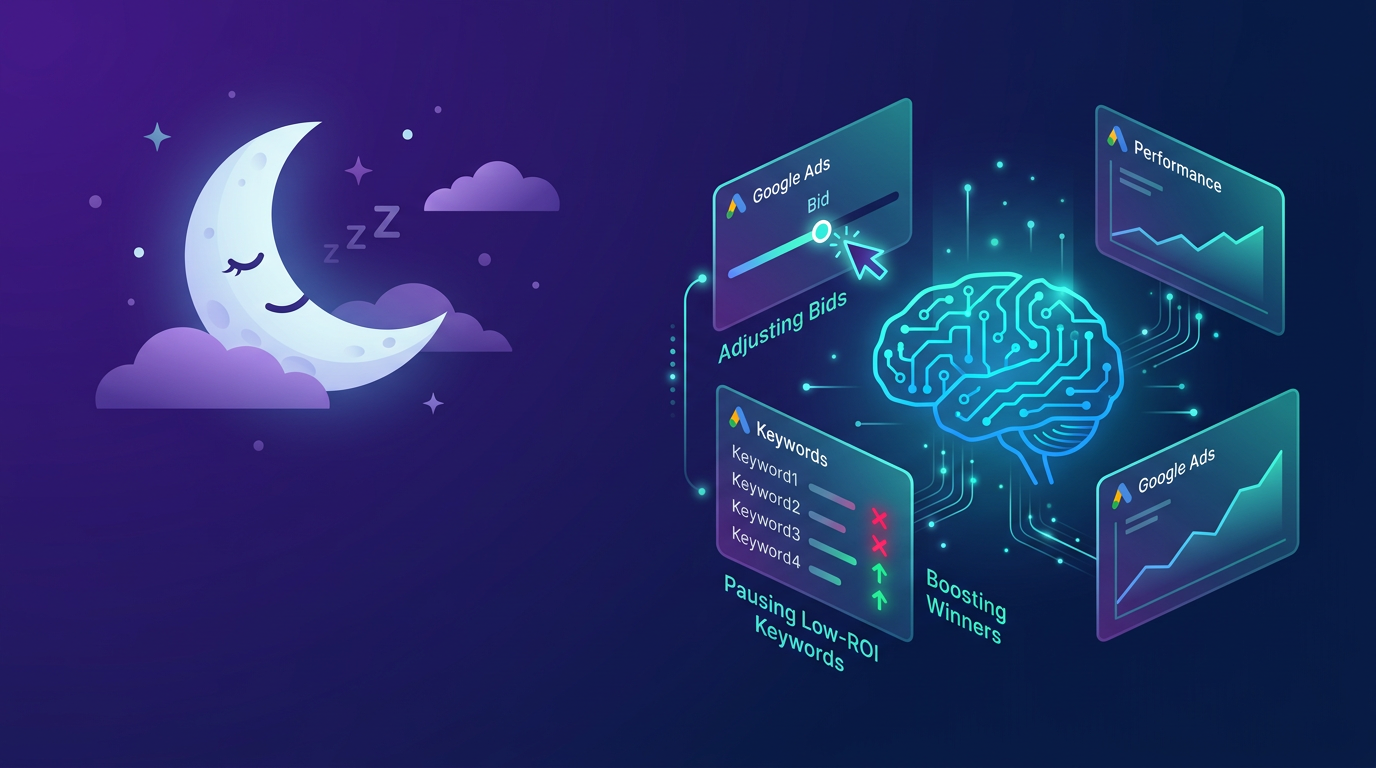
How AI Agents Optimize Google Ads While You Sleep
The 24/7 Problem with Paid Search
Google Ads does not take weekends off. Your campaigns are running at 2 AM on a Sunday, burning through budget on keywords that may have stopped converting three hours ago. A competitor might launch a new campaign at midnight that drives up your cost per click. A seasonal trend might shift buying behavior while your team is asleep.
Most businesses manage Google Ads reactively. They log in once a day, maybe twice, scan the dashboard, make a few adjustments, and move on. The gap between what is happening in the account and when someone actually notices creates waste that compounds over time.
AI agents close that gap entirely.
What AI Agents Do Inside a Google Ads Account
AI agents are not dashboards that surface recommendations you have to act on. They are autonomous systems that monitor, decide, and act within the guardrails you define. Here is what that looks like in practice across the core workflows of paid search management.
Bid Management
Manual bid management means checking keyword bids periodically and adjusting based on recent performance. At best, this happens daily. More commonly, it happens weekly.
An AI agent evaluates bid efficiency continuously. It considers time of day, device type, geographic location, day of week, audience segment, and competitive activity. When a keyword converts well on mobile during evenings but poorly on desktop during mornings, the agent adjusts bids by device and time automatically. It does this across hundreds or thousands of keywords simultaneously, processing data points that would take a human analyst hours to compile.
The result is tighter cost control and higher return on ad spend without anyone manually adjusting a single bid.
Negative Keyword Management
One of the largest sources of wasted ad spend is irrelevant search terms. Every week, your campaigns trigger for searches that have nothing to do with your business. A plumber bidding on "emergency plumbing" might show up for "plumbing school programs" or "plumbing video games."
AI agents review search term reports continuously, not once a week. They identify terms that consume budget without converting and add them as negative keywords before significant waste accumulates. Over time, this creates a progressively cleaner, more efficient keyword set.
Ad Copy Testing
Testing ad copy properly requires statistical discipline. You need enough impressions on each variant to draw meaningful conclusions, and you need to test one variable at a time to know what actually caused a change.
Most small businesses do not have time for this. They write two headlines, pick the one that "feels" better, and move on.
AI agents run structured A/B tests across headlines, descriptions, and extensions. They allocate traffic to variants, measure performance against your primary KPI (clicks, conversions, or revenue), and promote winners once results reach statistical significance. Then they start the next test. This continuous testing cycle compounds improvements over months, producing ad copy that has been refined through dozens of iterations rather than a single gut decision.
Budget Pacing and Reallocation
Budget pacing is deceptively tricky. Spend too fast early in the month and you run out before the highest-converting days. Spend too slowly and you miss opportunities. Distribute evenly across campaigns and you treat a top performer the same as a mediocre one.
AI agents manage pacing dynamically. They track daily spend against monthly targets, factor in day-of-week and seasonal patterns, and shift budget from underperforming campaigns to those delivering the best results. If one campaign is crushing its CPA target while another is struggling, the agent reallocates in real time rather than waiting for a human to notice in the weekly review.
Opportunity Discovery
Beyond optimizing what already exists, AI agents identify opportunities you might miss. They surface new keyword opportunities based on search term data, recommend new campaign types (Performance Max, YouTube, Discovery) based on your conversion patterns, and flag when a competitor exits or enters the auction.
This proactive approach means your account evolves continuously rather than staying static between quarterly strategy reviews.
What Stays Human
AI agents handle tactical execution exceptionally well, but they do not replace strategic thinking. The decisions that remain with your team include:
- Business goals and KPIs. The agent needs to know whether you are optimizing for leads, revenue, ROAS, or market share.
- Creative direction. While agents can test copy variations, the brand voice, value propositions, and messaging strategy come from your team.
- Budget allocation across channels. Deciding how much to invest in Google versus Meta versus LinkedIn is a strategic call based on business context the agent does not have.
- Landing page experience. Agents optimize what happens before the click. What happens after the click (your website, forms, and sales process) requires human attention.
The best results come from pairing strong Google Ads management strategy with autonomous execution. The human sets direction. The agent runs it 24/7.
The Compounding Effect
The real power of AI-driven optimization is not any single adjustment. It is the compounding effect of thousands of small, data-informed decisions made continuously over weeks and months.
A human manager checking an account once per day makes roughly 20 to 30 optimization decisions per week. An AI agent makes hundreds. Over a quarter, that difference compounds into meaningfully better performance: lower cost per acquisition, higher return on ad spend, and less budget wasted on search terms, times of day, or audience segments that do not convert.
For small businesses spending $2,000 to $10,000 per month on Google Ads, this compounding effect can mean the difference between a campaign that breaks even and one that drives profitable growth.
Getting Started
If you are currently managing Google Ads manually or through a traditional agency that checks in weekly, consider what continuous optimization could do for your results. The starting point is usually a campaign audit that identifies where the biggest gaps exist between your current performance and what is achievable.
Our AI Marketing Agents service deploys autonomous optimization across your paid search accounts alongside lead response and campaign management, so your ads, your budget, and your leads are all working harder around the clock.
Want to see what AI-powered optimization would look like for your Google Ads account? Schedule a campaign audit with our team.
Ready to Elevate Your Digital Strategy?
Let our team of experts help you achieve your marketing goals with AI-powered strategies tailored to your business.