AI Search Optimization for Small Businesses: The 2026 Playbook
Search Has Changed. Your Strategy Needs to Catch Up.
For years, search optimization meant one thing: rank on page one of Google. If you showed up in the top three organic results, you won. If you ranked in the local pack, even better. The playbook was clear: keywords, backlinks, on-page optimization, Google Business Profile.
That playbook still matters, but it is no longer complete.
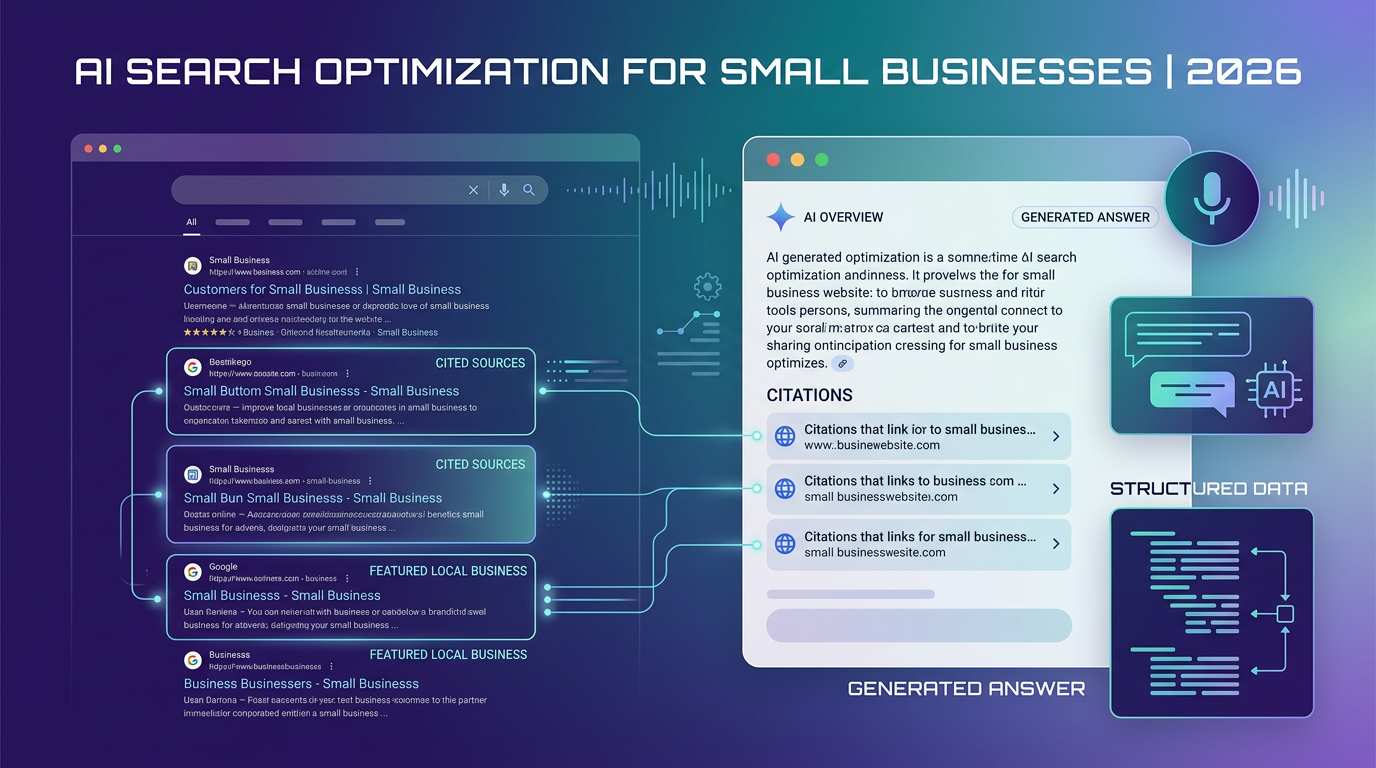
In 2026, a growing share of search queries are answered directly by AI. Google AI Overviews synthesize information from multiple sources and present a summary at the top of results. ChatGPT and Perplexity provide conversational answers that cite specific websites. Voice assistants pull from structured data and authoritative content to answer spoken questions.
For small businesses, this shift creates both a risk and an opportunity. The risk is that AI answers replace the click. The opportunity is that businesses optimized for AI search get cited in those answers, earning visibility and trust that their competitors miss entirely.
This playbook covers what small businesses need to do right now to show up in both traditional and AI-powered search.
Understanding Where AI Search Gets Its Answers
AI search systems do not pull answers from thin air. They draw from specific sources, and understanding those sources tells you exactly what to optimize.
Google AI Overviews pull primarily from pages that already rank well organically, combined with structured data (schema markup) and content that directly answers the query in a clear, concise format.
ChatGPT and similar LLMs were trained on web content and continue to access the web through browsing and retrieval tools. They favor well-structured, authoritative pages with clear factual statements, original data, and expert perspectives.
Voice assistants rely heavily on featured snippets, structured data, and Google Business Profile information for local queries.
The common thread across all of these: well-structured, authoritative, clearly written content with proper technical markup gets cited. Thin, generic, duplicated content does not.
The 2026 AI Search Optimization Playbook
1. Answer Questions Directly and Clearly
AI systems are looking for direct answers to specific questions. The clearest, most authoritative answer wins the citation.
For every service page and blog post, identify the core questions your customers ask and answer them explicitly. Use the question as a heading and provide a concise 2-to-3-sentence answer immediately below, followed by more detailed explanation.
For example, if you run an HVAC company:
Bad: "We provide comprehensive heating and cooling solutions for residential and commercial clients throughout the greater metro area."
Good: "A standard AC tune-up takes 60 to 90 minutes and includes refrigerant level checks, coil cleaning, filter replacement, and thermostat calibration. Most homeowners should schedule tune-ups once per year, ideally in early spring before peak cooling season."
The second version answers a specific question with specific information. That is what gets cited.
2. Implement Structured Data Across Your Site
Structured data (JSON-LD schema markup) tells search engines and AI systems exactly what your content represents. For small businesses, the most important schema types are:
- LocalBusiness or ProfessionalService: Your business name, address, phone, hours, service area, and accepted payment methods.
- Service: Each service you offer with description, price range, and service area.
- FAQ: Questions and answers that appear on your service pages.
- Article: Blog posts and guides with publish date, author, and topic.
- Review/AggregateRating: Customer reviews and overall rating.
Most small business websites have minimal or no structured data. Adding comprehensive schema markup is one of the highest-impact, lowest-effort changes you can make. It directly feeds AI systems the structured information they need to cite you.
Learn how our AI search optimization service handles this systematically.
3. Build Topic Authority Through Content Clusters
AI systems assess topical authority when deciding which sources to cite. A website with one blog post about HVAC maintenance is less likely to be cited than a website with 15 posts covering different aspects of HVAC care, repair, and installation, all interlinked.
For small businesses, this means building focused content clusters around your core services:
- Hub page: Your main service page (e.g., "AC Repair Services in [City]")
- Supporting content: Blog posts answering specific questions (when to replace vs. repair, common AC problems by brand, seasonal maintenance checklists)
- Internal links: Every supporting post links back to the hub page, and the hub page links out to the most relevant supporting content.
This structure signals to both traditional and AI search that you are a comprehensive authority on the topic. Read more about how to use internal linking to strengthen your service pages.
4. Optimize Your Google Business Profile for AI
Google's AI Overviews frequently pull from Google Business Profile data for local queries. Your GBP needs to be complete and current:
- All service categories selected accurately
- Business description using natural language (not keyword-stuffed)
- Services listed with descriptions
- Photos updated regularly (at least monthly)
- Q&A section populated with common questions and answers
- Posts published weekly with updates, offers, or tips
The businesses that treat their GBP as a living resource rather than a one-time setup consistently perform better in both local pack results and AI-generated answers.
5. Create Original Data and Insights
AI systems prioritize original information over repackaged content. If your page says the same thing as 50 other pages, there is no reason for an AI to cite yours specifically.
Small businesses can create original data from their own operations:
- Average response times for different service types
- Cost ranges based on actual jobs completed
- Seasonal demand patterns from your booking data
- Customer satisfaction metrics and trends
A plumber who publishes "Based on 500+ jobs in [City] last year, the average kitchen faucet replacement costs $280 to $450 including labor" creates a citable data point that no competitor has.
6. Prioritize Page Speed and Mobile Experience
Technical performance is a ranking factor for traditional search and influences AI crawling behavior. Pages that load slowly or render poorly on mobile are less likely to be indexed thoroughly.
For small businesses, the key technical priorities are:
- Page load time under 2.5 seconds on mobile
- Core Web Vitals passing (LCP, INP, CLS)
- Mobile-responsive design with readable text and tappable buttons
- Clean URL structure with descriptive slugs
- SSL certificate (HTTPS)
These are foundational. If your web design does not meet these standards, fix them before investing in content and schema.
What to Do This Month
If you are a small business owner reading this and feeling overwhelmed, here is a prioritized action list:
Week 1: Audit your Google Business Profile. Fill in every field. Add recent photos. Post an update.
Week 2: Add LocalBusiness and Service schema markup to your website. If you are not technical, this is a one-time setup your developer or agency can handle.
Week 3: Identify the five most common questions your customers ask. Write a clear, detailed answer for each one on your website, using the question as the heading.
Week 4: Publish one piece of original content with data or insights from your actual business. Link it to your main service page.
These four actions put you ahead of 90% of local businesses who have done nothing to prepare for AI search.
The Longer Game
AI search optimization is not a one-time project. It is an ongoing practice that compounds over time, similar to traditional SEO but with different mechanics. The businesses that start now build an advantage that becomes increasingly difficult for competitors to overcome.
If you want help building a comprehensive AI search strategy for your business, explore our AI search optimization services or see how AI marketing agents can handle the ongoing content and optimization work.
Want a custom AI search audit for your business? Get in touch and we will show you exactly where you stand.
Ready to Elevate Your Digital Strategy?
Let our team of experts help you achieve your marketing goals with AI-powered strategies tailored to your business.