AI Marketing Agents vs. Traditional Automation: What Changed in 2026
The Confusion Is Understandable
If you have been running email sequences in Mailchimp, drip campaigns in HubSpot, or automated workflows in Zapier, you might wonder what is actually different about AI marketing agents. Both automate tasks. Both save time. Both promise better results with less manual work.
The difference is not incremental. It is architectural. Understanding it will change how you think about scaling your marketing.
How Traditional Marketing Automation Works
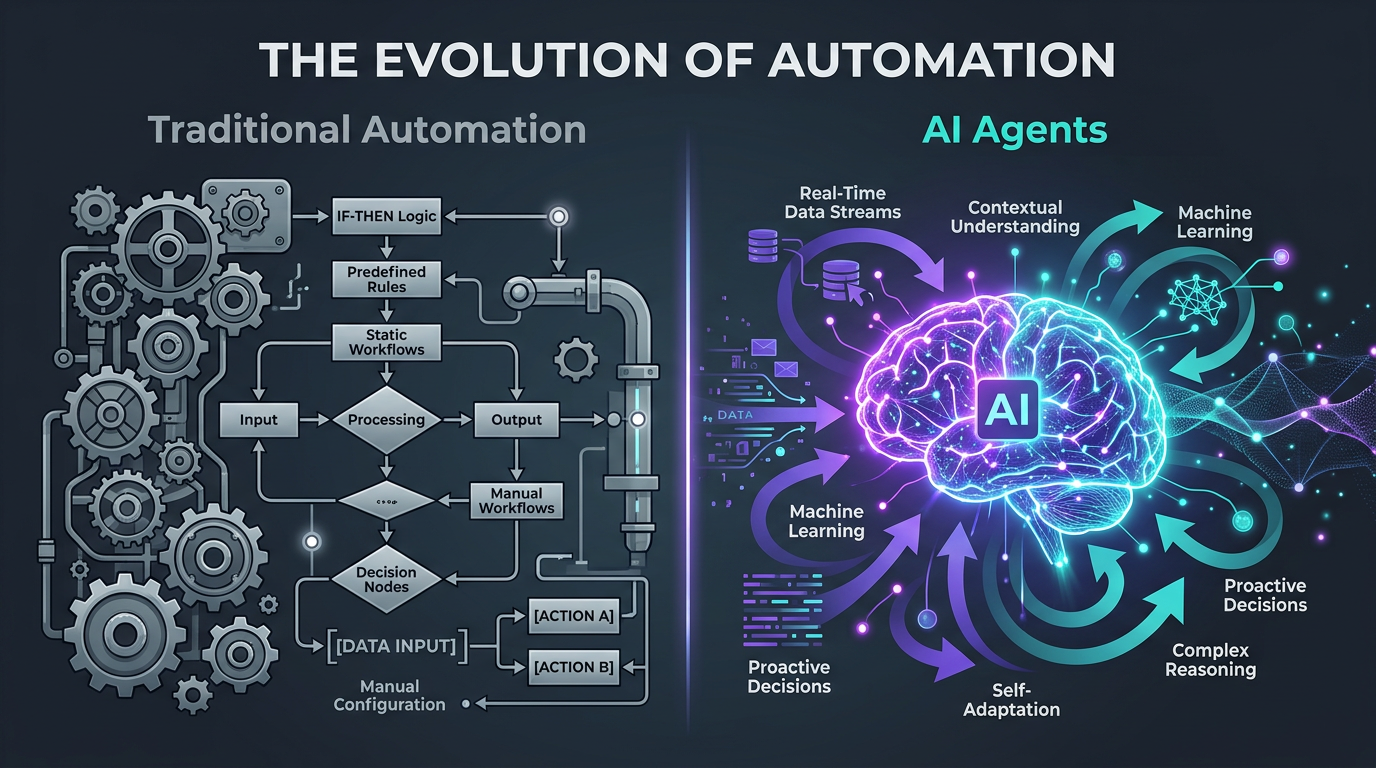
Marketing automation operates on rules you define in advance. The logic follows a simple pattern: when a specific trigger occurs, execute a specific action.
Examples:
- When a lead fills out a form, send a welcome email
- When someone abandons a cart, wait 2 hours, then send a reminder
- When a contact opens 3 emails in a row, tag them as "engaged"
This works well for repeatable, predictable scenarios. If your buyer journey follows a linear path and conditions stay constant, automation handles it reliably. The marketing automation industry is a $47 billion market, and 96% of marketers use some form of it.
But automation has a ceiling. It cannot adapt when conditions change. It cannot decide which of five possible actions is most likely to convert a specific lead. It cannot look at a campaign that is underperforming and figure out why. It runs the playbook you wrote, exactly as written, regardless of whether that playbook still makes sense.
How AI Marketing Agents Work
AI agents operate on goals, not rules. Instead of "when X happens, do Y," you define an outcome: "maximize qualified leads from this campaign" or "respond to every inbound inquiry within 60 seconds."
The agent then figures out how to achieve that outcome. It plans a sequence of actions, executes them, observes the results, and adjusts its approach based on what it learns. This cycle repeats continuously.
The same scenarios look different with agents:
- A lead fills out a form. The agent reviews their company size, industry, and browsing history, then crafts a personalized response and routes the lead to the right salesperson based on deal size and territory.
- Someone abandons a cart. The agent analyzes their session behavior, determines whether price, shipping, or product uncertainty was the likely cause, and sends a message addressing that specific objection.
- A contact engages heavily with content. The agent cross-references their activity with conversion patterns from similar contacts and decides whether to accelerate the sales sequence, recommend a different content path, or trigger a direct outreach from the sales team.
The Core Differences
Decision-Making
Automation follows predetermined paths. AI agents evaluate options and choose the best one based on current data. When a Google Ads campaign starts losing efficiency, automation keeps running the same bids. An agent recognizes the shift, tests new bid strategies, pauses underperforming keywords, and reallocates budget to what is working now.
Adaptability
Automation is static until someone updates it. AI agents learn continuously. They observe which subject lines get opened, which ad creative converts, which lead response patterns result in booked meetings, and they adjust without waiting for a human to notice and intervene.
Scope
Automation typically works within a single platform or workflow. AI agents operate across systems. A single agent can monitor your Google Ads performance, adjust your email sequences, update your CRM, and generate a report on what changed, all as part of one coordinated workflow.
Human Oversight
Automation requires you to build every pathway in advance. You have to anticipate every scenario. AI agents require you to set goals, define guardrails (what the agent can and cannot do), and review results. The agent handles the tactical decisions within those boundaries.
When to Use Each
The answer is not one or the other. The strongest marketing systems use both.
Use traditional automation when:
- The workflow is simple, predictable, and rarely changes
- Compliance or regulatory requirements demand exact consistency
- The volume is low enough that manual setup per workflow is practical
- You need a reliable fallback that works without AI infrastructure
Use AI agents when:
- The task requires judgment, not just execution
- Conditions change frequently (ad performance, lead quality, seasonal demand)
- You need to operate across multiple platforms simultaneously
- Speed matters (lead response, campaign adjustments, anomaly detection)
- Your team is too small to manage the volume manually
The Market Is Moving Fast
The AI agents market reached $7.6 billion in 2025 and is projected to pass $10.9 billion in 2026, growing at roughly 45% year over year. Meanwhile, 40% of enterprise applications are expected to embed task-specific AI agents by the end of 2026. This is not a future trend. It is happening now.
For small and mid-sized businesses, this shift is especially significant. AI agents let a five-person team operate with the responsiveness and optimization capacity of a 25-person team. The businesses adopting agents today are building a compounding advantage that will be difficult for competitors to close later.
What This Means for Your Business
If you are already using marketing automation effectively, you do not need to replace it. You need to layer intelligence on top of it. AI agents can work alongside your existing Mailchimp, HubSpot, or Salesforce setup, adding the adaptive decision-making that static workflows lack.
The practical starting point for most businesses is lead response. If your average response time is measured in hours, an AI marketing agent that responds in under 60 seconds will have an immediate, measurable impact on your conversion rate.
From there, the most common next step is campaign optimization, letting agents manage the daily bid adjustments, creative testing, and budget allocation that most teams do not have time to do properly.
Want to see how AI agents would work alongside your current marketing stack? Talk to our team about a custom assessment.
Ready to Elevate Your Digital Strategy?
Let our team of experts help you achieve your marketing goals with AI-powered strategies tailored to your business.