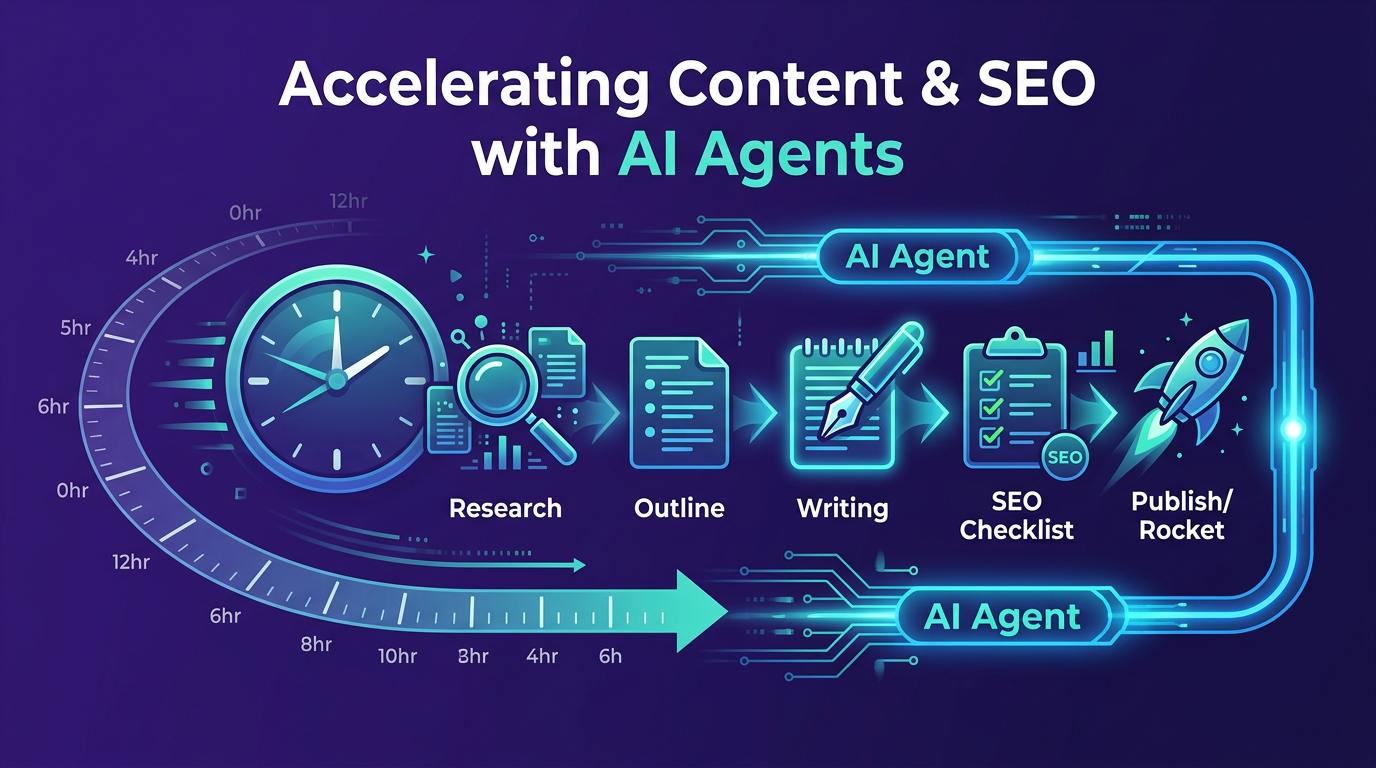
AI Agents for Content and SEO: From 8 Hours to 3 Per Article
The Content Bottleneck
Every marketer knows the formula. Publish consistent, high-quality content. Optimize it for search. Distribute it across channels. Watch organic traffic compound over time.
The problem is not the strategy. It is the execution. A single well-researched blog post takes 6 to 8 hours to produce when you account for topic research, keyword analysis, outlining, writing, editing, SEO optimization, image sourcing, formatting, and publishing. For a small team trying to hit 4 to 8 posts per month, that is 30 to 60 hours of dedicated content work, time most teams simply do not have.
AI agents are changing this math. Not by producing throwaway content, but by handling the labor-intensive stages of the workflow so your team can focus on the parts that require human expertise.
The Content Production Pipeline, Stage by Stage
Stage 1: Topic Research and Keyword Analysis
Without AI agents: A content strategist spends 1 to 2 hours scanning industry news, competitor blogs, keyword tools, and internal data to identify a topic worth writing about. They cross-reference search volume, competition, and relevance before committing.
With AI agents: An agent monitors trending topics in your industry, analyzes search term gaps between your site and competitors, and surfaces a prioritized list of content opportunities ranked by potential traffic impact and alignment with your service offerings. The strategist reviews the list and selects a topic in minutes instead of hours.
Stage 2: Outline and Structure
Without AI agents: The writer spends 30 to 60 minutes building an outline, deciding which subtopics to cover, what questions to answer, and how to structure the argument.
With AI agents: The agent analyzes top-ranking content for the target keyword, identifies the subtopics and questions that existing content covers (and misses), and generates a detailed outline with suggested headers, talking points, and internal linking opportunities. The writer reviews and adjusts rather than building from scratch.
Stage 3: First Draft
Without AI agents: Writing takes 2 to 4 hours depending on the depth and complexity of the topic.
With AI agents: The agent produces a complete first draft based on the approved outline, incorporating relevant data points, proper heading structure, and natural keyword placement. The writer edits for voice, accuracy, and brand alignment. This typically cuts the writing phase to 1 to 1.5 hours of editorial work rather than hours of original composition.
Stage 4: SEO Optimization
Without AI agents: Someone reviews the draft against an SEO checklist: title tag, meta description, header hierarchy, keyword density, internal links, alt text, schema markup. This takes 30 to 45 minutes and requires knowledge of current best practices.
With AI agents: The agent handles technical SEO optimization automatically. It generates meta descriptions, suggests internal links to relevant service pages and related blog posts, validates heading structure, checks keyword placement, and flags any issues. The human reviewer confirms the suggestions and publishes.
Stage 5: Distribution
Without AI agents: After publishing, someone manually creates social media posts, drafts an email summary for the newsletter, and schedules distribution across channels. This adds another 30 to 60 minutes per piece.
With AI agents: The agent generates platform-specific social posts (LinkedIn, Instagram, X), drafts a newsletter segment, and schedules distribution based on optimal posting times for your audience. Your team reviews and approves rather than creating from scratch.
The Net Result
When you add the time savings across each stage, the total production time per article drops from 6 to 8 hours to approximately 2.5 to 3 hours. The work that remains human is the high-value work: strategic topic selection, editorial judgment, brand voice, and quality assurance.
Marketing teams using AI agents for content operations report developing campaigns 73% faster and, critically, publishing more consistently. Consistency matters enormously for SEO, where publishing frequency and topical depth are key signals of authority.
What AI Agents Do Not Replace
It is important to be specific about what stays human in this workflow.
Strategic direction. Deciding what topics align with your business goals, which audience segments to target, and how content fits into your broader marketing strategy requires business context and judgment that AI agents do not have.
Brand voice and tone. AI agents can match a style guide, but the nuances of your brand's personality, the way you handle sensitive topics, the humor or seriousness that defines your identity, those come from people who understand the brand deeply.
Original insight and experience. The most valuable content comes from genuine expertise: lessons learned from client work, unique perspectives on industry problems, data from your own operations. AI agents can structure and present these insights efficiently, but the insights themselves come from human experience.
Final quality control. Every piece should have a human reviewer who checks for accuracy, tone, and alignment before publication. AI agents accelerate production. They do not eliminate editorial oversight.
Scaling Content Without Scaling Headcount
The real value of AI-powered content operations is not just speed. It is scale.
A small marketing team that could previously manage 2 to 3 blog posts per month can comfortably produce 6 to 8 without adding headcount. Over a year, that difference compounds significantly in terms of organic search visibility, topical authority, and the volume of indexed pages working to attract traffic.
For businesses investing in AI Search Optimization, content volume and quality are directly tied to how often AI systems cite your brand. The more well-structured, authoritative content you have, the more likely your business appears in AI-generated answers across ChatGPT, Google AI Overviews, and Perplexity.
Getting Started with AI Content Operations
The transition does not have to be all-or-nothing. Most businesses start by introducing AI agents at one or two stages, typically research and first draft, and expand as the team gets comfortable with the workflow.
The key is establishing clear quality standards upfront. Define your brand voice guidelines, editorial standards, and approval process before deploying agents. This ensures that increased speed does not come at the cost of the quality that builds trust with your audience and search engines.
Our AI Marketing Agents service includes content operations deployment as one of the core workflows, configured to match your brand voice, editorial standards, and publishing schedule.
Ready to produce more content without burning out your team? Talk to us about setting up AI-powered content operations.
Ready to Elevate Your Digital Strategy?
Let our team of experts help you achieve your marketing goals with AI-powered strategies tailored to your business.